
This year, his first in Congress, John McGuire was the main sponsor on ten bills, plus one resolution and an amendment.
Now, most bills never become law; most never even get out of committee. Indeed, the only one of his that’s been moved out of subcommittee is #1 on the list below.
Even so, the list of McGuire’s bills tells you a lot about his legislative priorities. Regardless of whether they get signed into law, are these the issues that matter to you and your family and your neighbors? It’s not a rhetorical question!
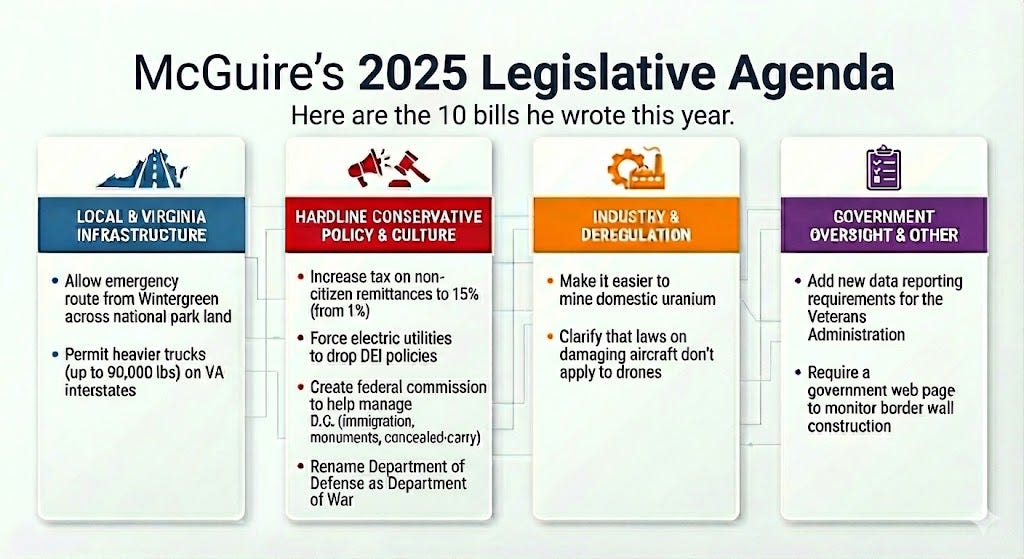
The bills he wrote this year would:
1. Allow an emergency route to be built from Wintergreen, across a patch of national park land, to the Blue Ridge Parkway.
According to congressional testimony, there’s only one road out of Wintergreen, which can get clogged during emergency evacuations with deadly results. (Many of the 100-plus people who died in the Lahaina fire two years ago were trapped in their cars while trying to get out.) Most of the new evacuation route has been built, but the National Park Service has refused to allow construction of the portion that would involve pouring gravel across roughly 30 feet of national parkland. McGuire’s bill would require the feds to green-light the project.
Co-sponsors: Seven other Virginia reps have signed on to the bill. The two that haven’t are Bobby Scott from VA-03 (Norfolk and Newport News) and Don Beyer from VA-08 (Arlington and Alexandria).
FWIW, the National Parks Conservation Association opposes the bill, arguing that Wintergreen developers should finish the road on private land.
2. Tax non-citizens at least $10 billion a year more for sending money home.
Under current U.S. law, remittances are taxed at 1 percent. (Send $100 home and you owe Uncle Sam a dollar.) McGuire’s bill would increase that to 15 percent, with exceptions for citizens and U.S. nationals.
Lowball estimates put the annual figure for remittances from the U.S. at $100 billion a year, and the range of figures I found online suggests that at least 70 percent of that comes from noncitizens. If McGuire’s bill becomes law, that adds up to at least $10 billion in new taxes paid by people sending money home—or, in other words, $10 billion less going back to families who often really need the money. Not to mention the additional paperwork for every company that does wire transfers, because the bill would require them to prove to the government that they’ve verified the citizenship status of every customer.
Republicans, the party of lower taxes and less bureacracy!
Co-sponsor: Republican Michael Rulli of Ohio.
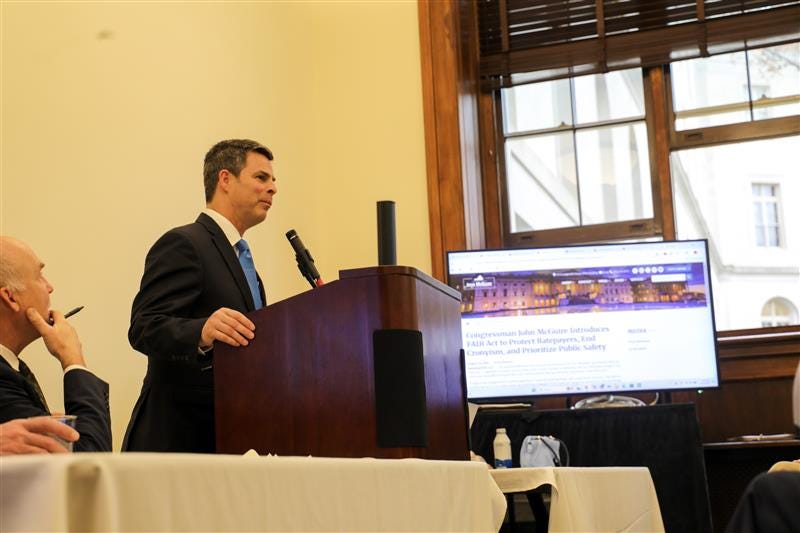
3. Force electric utilities to drop DEI policies.
McGuire’s bill would prohibit state regulators from okaying rates charged by any electric utility that “engages in, or retains or employs a consultant or an advisor to promote or enforce, a diversity, equity, or inclusion practice.” It’s named, apparently without irony, the Fair, Affordable, and Inclusive Rates Act.
“Churches, small business, and low-income households, shouldn’t be forced to pay extra to fund woke, leftist social engineering projects,” McGuire explained in his newsletter this week. “Businesses should care about delivering reliable, affordable, and FAIR services to the public.”
Co-sponsors: None.
4. Let bigger trucks haul crops and logs on Virginia interstates.
Current law doesn’t allow trucks over 80,000 pounds on interstate highways. McGuire’s bill would allow Virignia to issue permits to go as high as 90,000 pounds.
Co-sponsors: Virginia Democrat Eugene Vindman and Republicans Robert Wittman and Morgan Griffith.
5. Make it easier to mine domestic uranium.
I wrote about this one back in March.
Cosponsors: Seven Republicans from other states.
6. Expand federal law enforcement in D.C.
This fall, House Republicans passed a tranche of bills they said were designed to fight crime in Washington. McGuire’s contribution would create a federal commission charged with expanding immigration enforcement, beautifying federal monuments, and issuing concealed-carry permits faster. (This is explicitly mentioned in the bill.)
The mayor, attorney general, and city council chairman are opposed to the whole legislative package.
Co-sponsors: Four Republicans from Louisiana, Georgia, California, and Mississippi.
7. Add new reporting requirements for the Veterans Administration.
McGuire’s VA Data Transparency and Trust Act would require the federal government to produce enhanced annual reports tracking the number of vets receiving care, health conditions, outcomes, and various other metrics—some of which are already reported, some of which are not.
Congressional Democrats have worried that Trump might try to weaken the VA’s reporting requirements. It’s not clear to me whether McGuire’s bill would address their concerns or exacerbate them. In any case, if the bill becomes law, it may come down to whether the VA interprets it as replacing the existing list of data it has to report, or simply adding to it.
Co-sponsors: Eight Republicans.
8. Clarify that shooting down a drone isn’t as illegal as blowing up a passenger jet.
Under federal law, it’s a felony to “willfully damage, destroy, disable, or wreck any aircraft.” So, technically, taking down someone’s $100 hobby drone could be prosecuted under the same law that bans blowing up a passenger jet. In practice, prosecutors haven’t used the law that way, but McGuire’s bill would clarify that these laws apply to manned aircraft only. As far as I can tell, it doesn’t address what happens if, say, a protestor takes down a drone run by police or ICE. But it seems like a good start.
Co-sponsors: None.
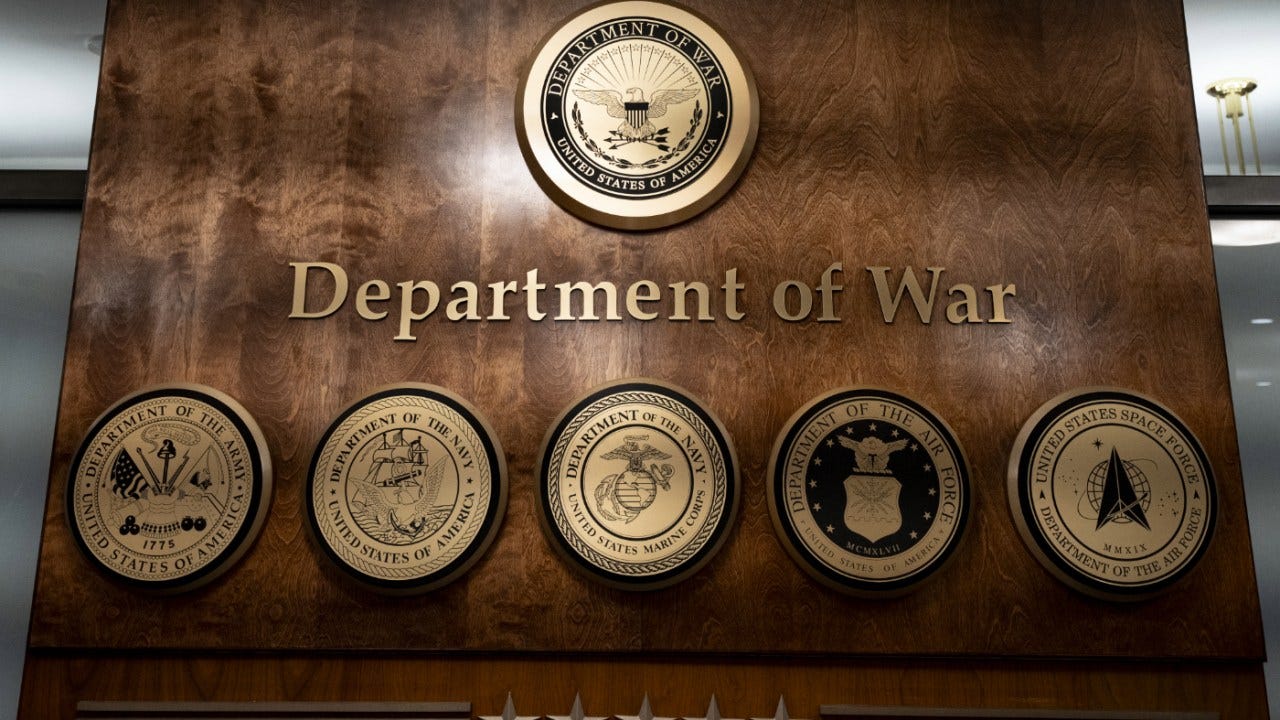
9. Finishing renaming the Department of Defense.
Trump renamed the Department of War by executive order earlier this year, but the change won’t be complete without an act of Congress. McGuire’s bill, the Peace Through Strength Act, would do it.
Co-sponsors: None.
10. Require the government to set up a web page where you can monitor the building of the border wall.
Co-sponsors: None.
Plus…
McGuire introduced a resolution honoring Hampden-Sydney college on its 250th anniversary and offered an amendment about artificial intelligence to a bill on protecting the electricity supply chain.